
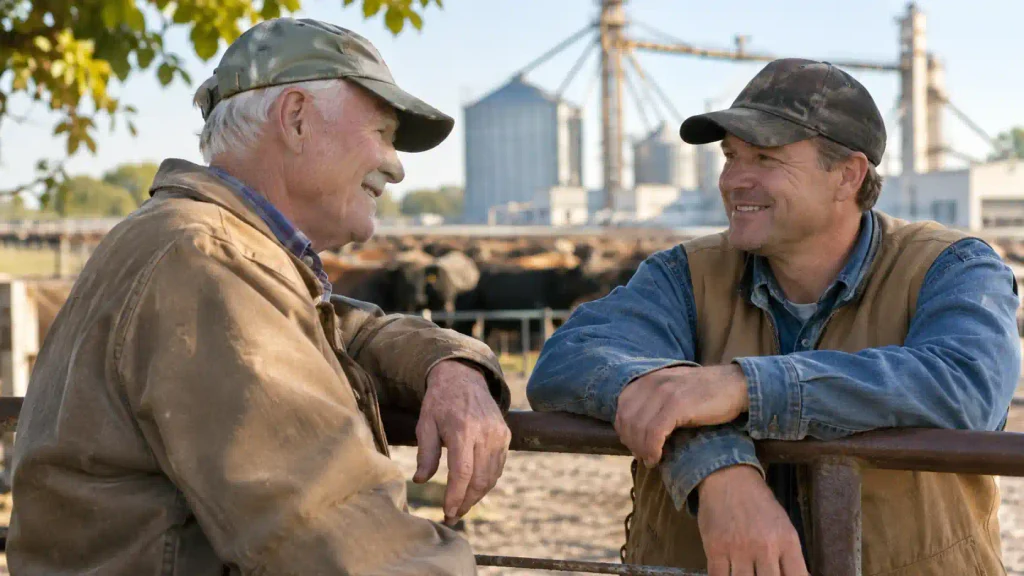
Dave Kier is well known in the Iowa agricultural world for excellence and trust in business. He and his team built DFS Feeds, a large animal feed company in northwest Iowa. We are grateful for his fourteen years serving on the IBEC board, and for his regular written leadership tips. He wrote this one in October 2026.
As I was working alongside my dad, growing a startup company in a highly competitive and rapidly changing industry, I learned that although my dad was gifted as an entrepreneur and exemplified exceptional customer service, his greatest asset was “trust.” When a farmer started doing business with Dad, he learned he could trust him—not only to do what we said we would do, but also to place his customers’ best interests above his own. Furthermore, this sense of trust often resulted in customers coming to Dad for advice beyond their feed needs, seeking his guidance on animal health problems or financial difficulties. Soon, even personal family issues were shared as advice was sought. Business is more than making money. Business is about building relationships around trust.
Today, in this age of “mega,” where non-owners lead businesses owned by investors at arm’s length from daily operations, trust is reflected in the people with whom customers interact. The person at the front desk of a Marriott hotel represents the company and its reputation. It was no different with our feed company. Just as many of those who tended the livestock did not own the animals, those who made and delivered their feed did not own DFS. In a sense, we are all representatives of others and, most importantly, as Christians, we are representatives of the Lord. Sadly, I have seen those who claim to be doing business for ministry purposes fall short in the area of trustworthiness, as though ministry and excellence in business carry different expectations.
Trust is earned, and it is earned by being trustworthy. In the parable of the talents, we read about those who were diligent and trustworthy in generating a return for the owner, while one did nothing with what was given to him. In real life, there is yet another possibility: someone who turns what was given into a loss. Or is producing nothing the same as producing a loss? There’s no middle ground. The best steward received the highest recognition. This is the way it is in business. The customer gives you his trust by continuing to do business with you. You then have a choice to make. Am I going to take that trust and build upon it by delivering more than expected? Am I going to give only what the customer paid for? Or, as the devious might think, can I hold back and give the customer less than he paid for?
In our feed business, we came to understand our customers’ needs by placing ourselves in their shoes, asking what we would expect from a feed supplier and what would be nice “if…” As we considered that question, we also asked ourselves what we expected from our suppliers and what made some suppliers more valuable than others. The word “trust” kept coming up. Trust that our suppliers had our best interests at heart. Trust that they would deliver what they promised on time. Trust that we were more than a means of generating income. The results of trust are measurable. We developed unique and comprehensive metrics to measure the quality and productivity of our products and services. These metrics provided the means by which we could continuously improve in all areas. In the parable of the talents, we read that each was given an amount “according to his abilities.” If you aren’t improving, you are going backwards. You can and must continuously improve your “abilities.”
Our customers trusted us, and our business grew to the point that, when we announced we were selling the company, a large producer called to express his disappointment that we would no longer “set the standard” for the industry. I say that not to boast, but to encourage you not merely to think you are trustworthy to your customers, but to prove it—first to yourself. Results matter. When results are measured, they can become more predictable. Your results reflect your trustworthiness. As a member of the Kingdom of God, just how trustworthy are you to your customers, your lenders, and your staff, and how are you building upon this trust? If you are not measurably improving, you are going backwards.
Larry W. Sharp, BAM Support Specialist, IBEC Ventures
Larry.Sharp@ibecventures.com