
Piper Lowell is an IBEC Leadership Team member and recently participated in the Freedom Business Alliance conference held in Bali, Indonesia. Her article here provides useful background, meaningful insights, and is a source of hope in relation to this gigantic world problem.
When we think of human trafficking, we think about it as a moral scourge. And it is.
We hate it as a form of oppression. And it is.
We don’t usually categorize it as an economic failure. But it is. One of the stickiest traps is offering a job in a desolate economic landscape. The offer doesn’t look like oppression. It looks like a way out of poverty.
So, if you are interested in Kingdom businesses or fighting human trafficking, consider:
- Globally, an estimated 40.3 million people fall victim to human trafficking each year, with 24.9 million trapped in forced-labor situations. Women and girls account for roughly 71% of all victims, and children represent about 25% of the total. Rarely is someone actually kidnapped. An estimated 95 percent of people in trafficking are forced or manipulated, often through debt bondage or the promise of work.
- Without access to safe, dignified employment, survivors often return to the same conditions or worse.
- The data reveals another sobering reality: only 30-35% of survivors secure stable, formal employment within two years of rescue. The majority end up in precarious or informal work with low wages and excessive hours, leaving them vulnerable again.
- Forced labor survivors face roughly three times the risk of re-exploitation compared with other groups.
Free labor generates over $150 billion in illegal profits per year. Yet, survivors who escape often receive minimal livelihood assistance, and comprehensive reintegration services remain rare.
These aren’t just statistics. These are people who need work to stay free. Freedom businesses – businesses that exist to give legal, dignified work – sit at the heart of prevention and aftercare.
The Freedom Business Alliance helps people start, grow, support, and improve businesses to employ people who are coming out of human trafficking or are at a high risk of violence.
This work is so important to IBEC, that two of us came to their conference this year to explore how we could partner with the organization.
I got a front-row seat—really, a side-table seat with a clipboard and a schedule – to listen for threads connecting topics, heartbreaks, and celebrations across three packed days.
One Comment Tells the Story
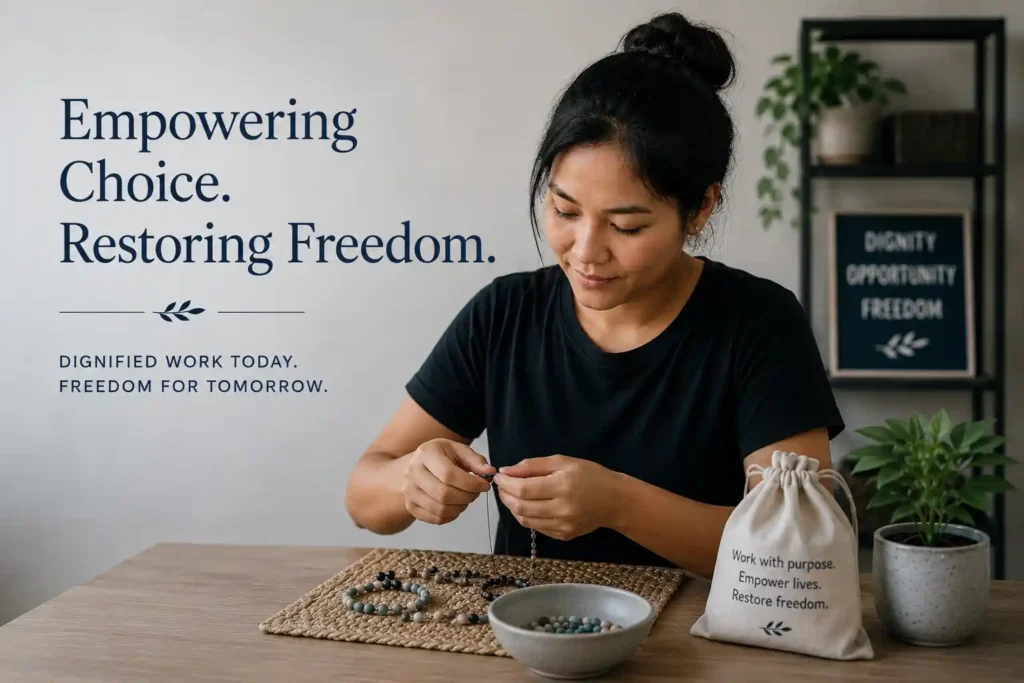
Amid discussions on mental health support, business structures, and elevating product lines, one comment grabbed my attention and continues to catch my breath. A business owner mentioned that an employee didn’t like her first assignment. “She didn’t want to do sewing, so we moved her to jewelry-making.”
It was a casual comment on the way to the point she was illustrating. In any conventional business where managers adjust roles constantly, this comment wouldn’t even be a footnote. But consider what this employee survived.
She didn’t choose the line of work she was forced into. She didn’t choose the person who controlled her. She didn’t decide what she ate, where she slept, or what she wore. Her choices were stripped from her.
But at this freedom business, she got to choose.
For someone coming out of forced labor who never selected what product he made, or from forced prostitution where she herself became the product sold, that choice carries weight beyond productivity. She got to decide what she would do next.
“She didn’t want to do sewing, so we moved her to jewelry-making.”
That throwaway line captures something essential. In a world that took choice away from this employee, a business chose to give it back.
Her employers opted out of maximizing profit in order to lay down their lives for the sake of others—to help people out of entrapment and help survivors stay free. What they chose to do with their business skills created dignity along with a paycheck.
Businesses that Choose to Act
This kind of transformation is why IBEC supports the FBA. Every survivor who stays employed instead of returning to exploitation validates the approach.
The work can feel small. FBA businesses tend to be bakeries, handcrafted products, and hospitality vendors. It feels overwhelming to stand against organized crime and corrupt societies armed with cupcakes and tote bags.
However, FBA businesses keep baking, sewing, and training, trusting that the God who hates injustice will end it, and knowing that businesses have a large role in the fight.
If you are interested in business coaching or in the role that employment plays in recovery from violence or trauma, please contact IBEC at Robert.bush@ibecventures.com. We would love to talk with you about it.
Larry W. Sharp, BAM Support Specialist, IBEC Ventures
Larry.Sharp@ibecventures.com