
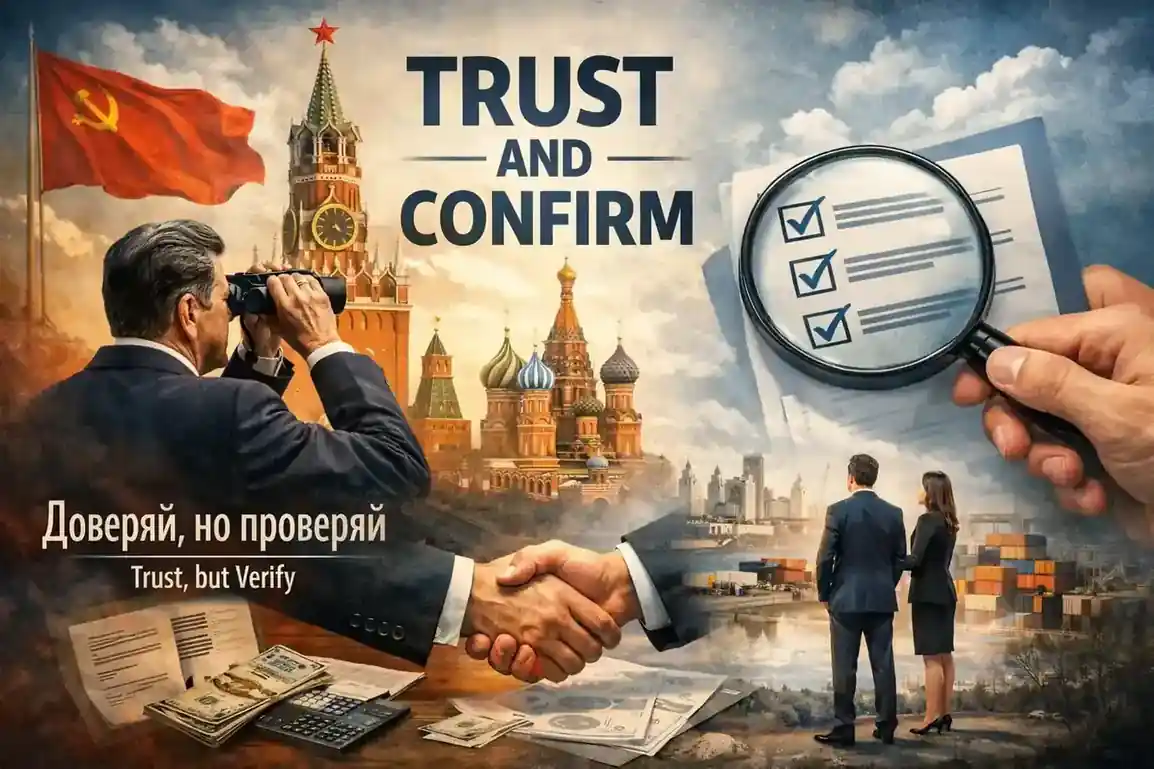
President Ronald Reagan often quoted the Russian proverb taught to him by American scholar, Suzanne Masssie. The proverb doveryai, no proveryai (доверяй, но проверяй) means ‘trust, but verify’. She advised him that “The Russians like to talk in proverbs…” Reagan applied the idea in his dealings with the Soviets where he added, “Don’t be afraid to see what you see.”
It seems to me that the concept of “trust but verify” is an oxymoron, and when used in comparative context, the conjunction “but” renders whatever comes before it as moot. Ben Whipple suggests a refinement by changing the phrase from “Trust but verify” to “Trust and confirm” to make the “…phrase less of a dichotomy and more operational. The reason we must confirm is that, while we want to trust that the other person proves to be trustworthy in the end, there is a finite chance that the person either did not understand or is not capable of performing as expected.”1
Whipple continues, “The confirmation process is merely part of the due diligence that recognizes the fact that activities do not happen in a vacuum. There may be other parties involved, and often we act as the agents for others as we trust someone to perform a task. Confirming that things are done correctly is just being prudent and being true to the trust others have in us. If people know we are responsible in our due diligence, they will be more likely to perform to a high standard.”
Why am are surfacing this idea?
Because it applies to business, not just politics. It applies to Business as Mission.
Recently, I learned from a good friend that considerable investment monies in a BAM project are at risk due to recipient leader mismanagement and failure to follow sound principles such as fiscal discipline and integrity. He lamented, “I was too trusting” and “I didn’t practice what I preach.” He went on to say he got involved with his heart instead of his head.” My heart cried out to God for my friend who is as wise and honest as any I have known.
In this case, millions of dollars are at stake, and the situation is complex with cultural histories and nuances making understanding difficult. Yet, it is not just about financial resources. The good name of our Lord is at stake. My friend’s good name and the reputation of others is at stake. Numerous scriptures remind us of the value of a good reputation, such as Ecclesiastes 7:1 A good name is better than fine perfume…”
I encouraged my friend not to second guess himself since there are circumstances beyond his control such as other investors, cultural subtleties, and it is always hard to “see what you see” from afar. However, any debrief must always ask the question, “what can we learn from this?” For all of us in the BAM world, when considering leadership and investing funds, let us remember “Trust and Confirm.”
1 Bob Whipple, Leadergrow, 2020
Larry W. Sharp, BAM Support Specialist, IBEC Ventures
Larry.Sharp@ibecventures.com