
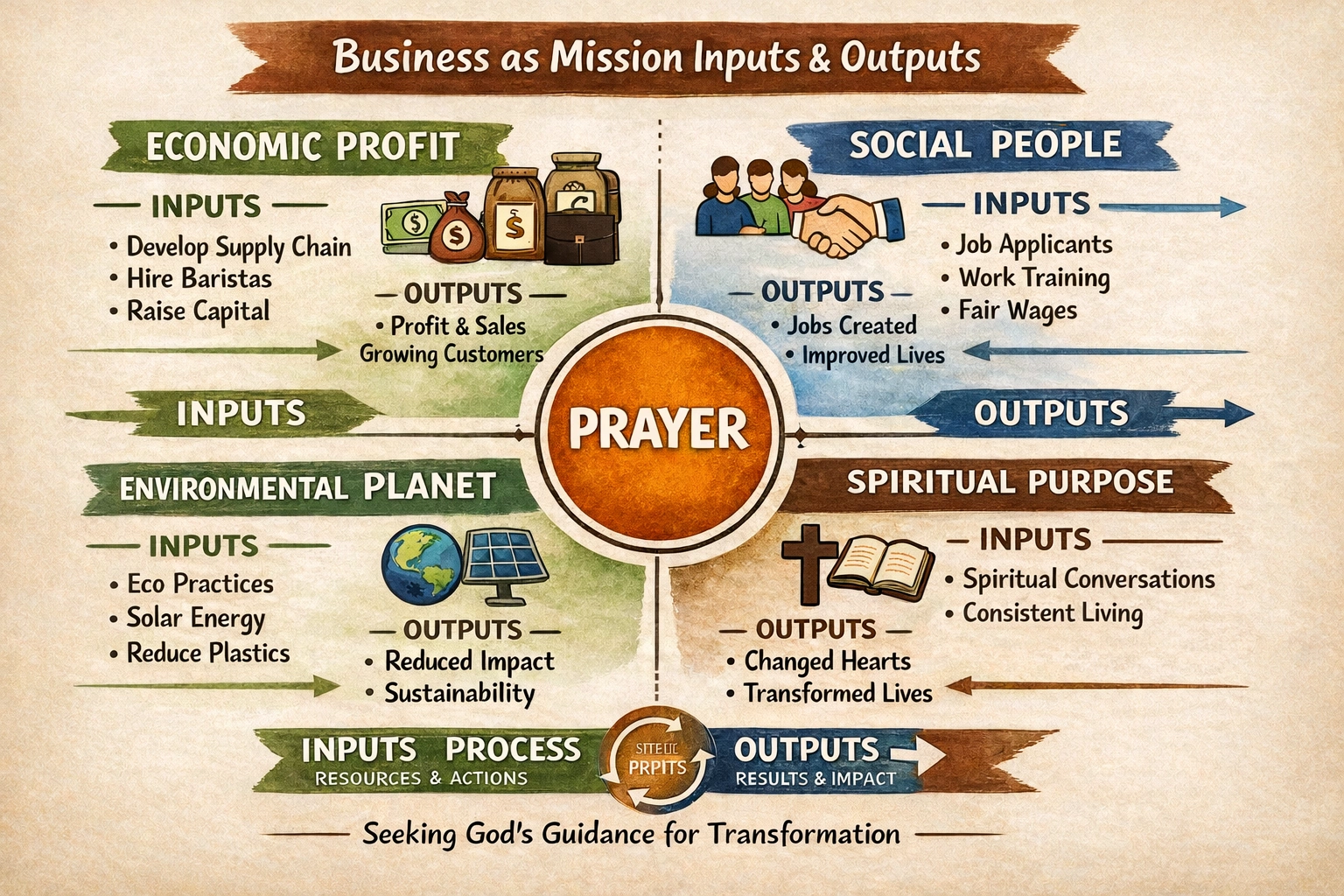
Does the Bible talk about inputs and outputs? How about process and outcomes? Well, it doesn’t do so in business terminology, but it sure does.
- What is an input? Input metrics, also known as leading indicators or process metrics, focus on the resources, activities, or inputs that contribute to desired outcomes. They help us understand what goes into the process. They are resources such as raw materials, energy, money, or efforts such as hours worked, research and development investment.
- What is an output? Outputs show us what comes out from the input, or results. They are the products such as finished goods or services or results such as sales, profit, or customer satisfaction.
- In summary:
- Input metrics really zoom in on what goes into a process; they are things we can and do control.
- Output metrics really zoom in on what results from a process; they measure what you ultimately get.
Both types of metrics really play an important role in giving us a full picture of performance evaluation. Input metrics are great for fine-tuning processes, and output metrics give us a way to gauge our success. When you put them together, you get a clear picture of how smoothly a business runs.
Let’s use a BAM case study – a retail coffee company in a former Soviet Republic This company was started with the Quadruple Bottom Line as a guide. They aimed at profitability but with a keen focus on the social and spiritual, and all the while respecting the environment.
Job creation was an important purpose since so many young people wanted to leave the country due to high levels of pollution and unemployment. There was a wonderful opportunity to educate in free market economic principles and in Christian values.
In a traditional tea culture, coffee was chosen because it represented the common beverage of the West, something of intrigue in the early 1990s. A coffee shop was a place of connection, and they built rooms for training in economics and Biblical values.
Note in the grid the subtitles of PROFIT, PEOPLE, PLANET AND PURPOSE.
| Overriding Purpose | Inputs | Outputs |
| Economic Good; wealth creation; PROFIT | *Develop coffee supply chain
*Raise startup capital *Hire two baristas *Research market appetite |
*Positive income statement (profit)
* Sales goals; EBIT; *Increasing customers |
| Social Good; job creation; social justice; PEOPLE | *Number of job applicants
*Theology of work developed *James 1:27 *Above average salaries/benefits |
*Students studying
*Higher living standard *End of exploitation * More and more jobs |
| Environmental Good; stewards of creation; PLANET | *Supply chain monitored for respect of environment
* Limited use of plastics * Solar energy panels in use |
* Meet ISO, ESG guides
*Reduced energy grid *Transparent disclosure of biodiversity footprint |
| Spiritual Good; Transformation of lives; PURPOSE | *Consistent living Christian values
*Opportunity to “see” Jesus *Spiritual conversations *Daily prayer for employees |
*True heart change
*Transformation of communities *Spiritual health growth |
It may be noted that the Economic, Social, and Environmental outputs can be quite easily quantified with a metric which most people would understand. Think of numbers for economic profit, jobs created, and environmental regulations. These measurements detail the results of many inputs.
However, when it comes to the spiritual, the output suggests heart change, transformation and spiritual health, somewhat less tangible, especially when the scriptures seem to indicate that the Spirit of God alone brings people to salvation.
Heart transformation is primarily the work of the Holy Spirit. In Ezekiel 36:26-27 , God promises, “I will give you a new heart and put a new spirit within you; I will remove your heart of stone and give you a heart of flesh. And I will put My Spirit within you and cause you to walk in My statutes and to carefully observe My ordinances.”
The evidence of a transformed heart is seen in the fruit of the Spirit, as described in Galatians 5:22-23 : “But the fruit of the Spirit is love, joy, peace, patience, kindness, goodness, faithfulness, gentleness, and self-control.” These qualities reflect the character of Christ and are the natural outflow of a heart that has been renewed by the Holy Spirit.
In relation to a study of Inputs and Outputs; inputs are things we can control. We do inputs so that the output results. In the Purpose category, we also control inputs, but we cannot control outputs in the same sense that we can control the income statement or the workers on the payroll, etc. That depends on someone outside of us, and that is where prayer comes in – where dependence on God is essential. That is why an IBEC graphic of our coaching process places prayer at the center of it all.
For future understanding:
https://blog.gembaacademy.com/2022/07/15/the-four-types-of-measures-and-why-each-is-important/
https://www.kpi.zone/blog/understanding-input-and-output-metrics/
https://www.graphapp.ai/blog/input-metrics-vs-output-metrics-understanding-the-difference
https://thenorth.io/input-metrics-vs-output-metrics/
https://www.deepsky.co/vital-numbers-x-key-metrics/input-metrics-vs-output-metrics/
Larry W. Sharp, BAM Support Specialist, IBEC Ventures
Larry.Sharp@ibecventures.com