
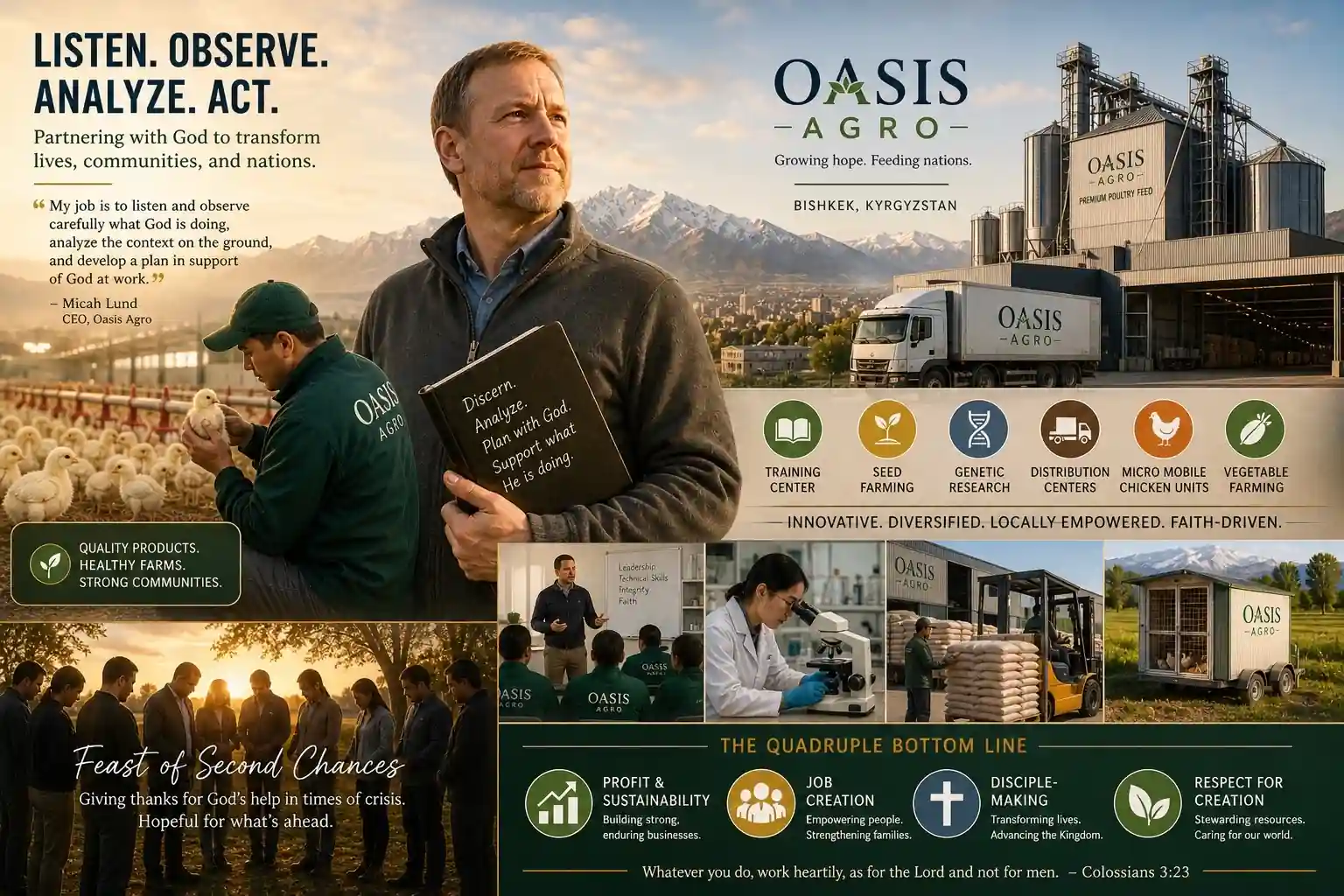
“My job is that of a detective,” stated Micah Lund shortly after we met.
What?
I thought we would be talking about a significant agribusiness, Oasis Agro, in Central Asia where he serves as the CEO. I had learned about his robust work in the development world with organizations like the Peace Corps and USAID, while learning three languages common in the region; and the MBA he had earned on his pathway to business leadership.
But a “detective”? What is that all about?
“My job is to listen and observe carefully what God is doing, analyze the context on the ground, and develop a plan in support of God at work,” Micah affirmed.
OK, I am listening – tell me more.
Most business leaders I have observed and interviewed talk about the project, the growth, and the challenges in developing a coffee shop, a manufacturing plant, a software process, a fabric shop, a tourism opportunity, or many other such industries. All good! Still, this was different.
As with most, Micah listens to God, trusts Him for direction and solving problems, and clearly integrates faith and spirituality into the fabric of the businesses. Did I say “businesses” plural? I thought we were going to talk about chickens, the food industry, and feed plants.
Well, we did, but what struck me most was the innovative nature of Micah and his team, their careful analysis of the culture, the way the world is changing, and their vision for industries anchored in independent faith-driven locally trained resources. They were learning to pivot when the circumstances suggested that God was saying to pivot.
Yes, Oasis Agro at its core is a provider of everything a chicken farmer needs to succeed: broiler and layer chicks, farm equipment, and excellent feed. They produce all of this in their facilities in Bishkek, Kyrgyzstan. Their poultry feed is trusted to be the highest quality in the region, and it sees demand across borders in neighboring countries.
More than one hundred employees devote their energy to being probably the best poultry feed mill in the country; but what about these other companies Micah spoke about – the fruit of innovative diversification thinking?
Everything is good about a focused single product company but there are risks as with anything. Micah cites Stanley McChrystal who makes the case for merging the power of a large corporation with the agility of a small team to transform any organization.1 “The basic DNA we’ve got to implant in leaders now is adaptability: not to get wedded to the solution to a particular problem, because not only the problem but the solution changes day to day. Creating people who are hardwired for that is going to be our challenge for the future.” The result is not just a robust company but one that is both robust and resilient.
In a similar vein, Jeffrey Shaw writes in Entrepreneur magazine2, “…focus until you are well-known for a core offer, and until brand recognition takes hold. Only then will you have gained the freedom to add multiple streams of income, establishing yourself as a growing business and creating enough diversity to ensure that it can withstand the inevitable changes to come.”
What are those “multiple streams of income” which provide the diversification to “withstand the inevitable changes to come.”? The board of directors of the holding company in the Netherlands has led the way with Mr. Lund in sponsoring spin off independent companies with close ties to Oasis Agro.
Kyrgyzstan faces numerous challenges and opportunities, and Mr. Lund wants to be ready, not just to survive but to thrive. Thrive without foreign support, while retaining the talent of the country’s youth for the sake of the church as well as the economy. These companies include a training center, seed farming, genetic research, distribution centers, Micro Mobile Chicken Units, and vegetable farming, among others.
All of these companies keep focused on the practical and spiritual “raison d’etre.” It is all about transformation and the Quadruple Bottom Line – profit and sustainability, job creation, disciple-making, and respect for creation. As they face challenges and realize opportunities, the employees of these various companies meet annually in a “Feast of Second Chances” where members of the team lead in prayer, and express their thanks to God for help in times of crisis and hope for the future.
1 Stanley McChrystal, “Team of Teams,” 2015
2 Jeffrey Shaw, Entrepreneur magazine, Nov 10, 2021
Larry W. Sharp, BAM Support Specialist, IBEC Ventures
Larry.Sharp@ibecventures.com