
It has been a long time since I was in business school and it seems I don’t remember much; however, there is something I do remember. It is the question, “why does one start a business?” The answer (and the books remind us) is to either solve a problem, or meet a need, or follow an opportunity.
Most every business you can think of either solves a problem or follows an opportunity. It is true for all the businesses near me in the Northwest – Starbucks, Amazon, Microsoft, Boeing, Costco, REI, Nike, Intel, Nordstrom, T-Mobile, and Alaska Airlines. All of these and all the businesses in your back yard.
One world event that creates fertile soil for business is a crisis. When there is a crisis, like a war, famine, earthquake, massive unemployment, social dysfunction, or revolution, there are problems to solve, people are in need, and there is opportunity. Just think about the many wars going on today. We hope and pray they will cease soon – but what then? After Ukraine, after Gaza, after Iran, after Lebanon, after Sudan, after Myanmar and many other smaller conflicts! What then, should peace prevail?
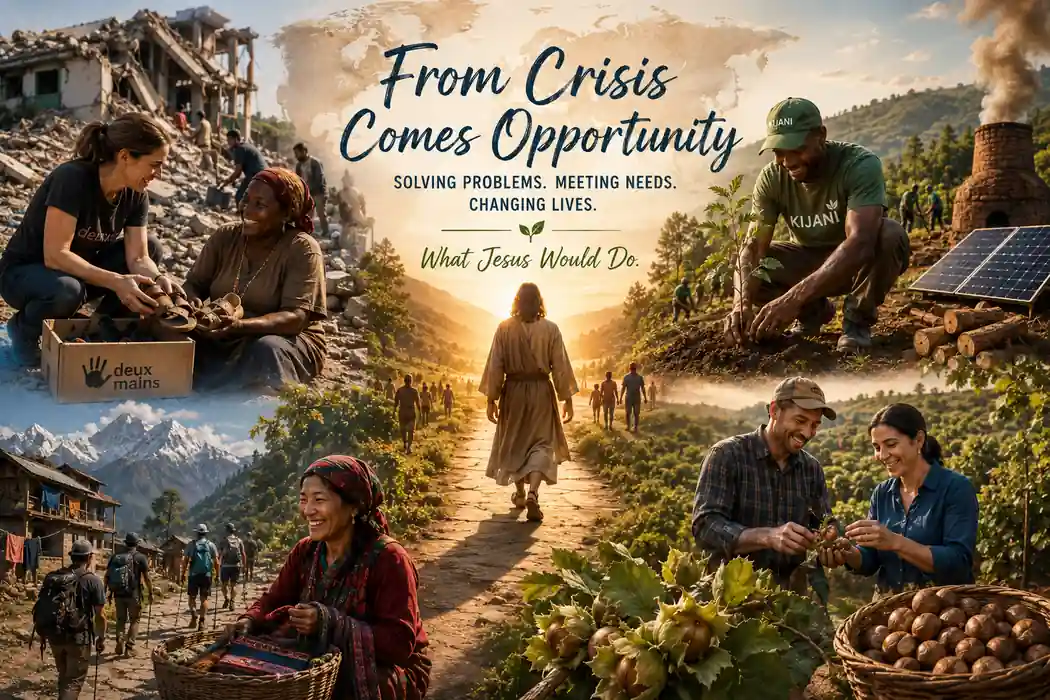
Many of IBEC related businesses started out of conflict or disaster – think Haiti, Uganda, Turkey, Bosnia, Nepal and others.
The Haiti earthquake in 2010 killed more than 200,000 people. I was involved in facilitating monies and God’s people with skills to go to Haiti to address the emergency.
Julie took a week off from her work and went down to help. Upon her return and after much prayer and reflection, she sold her home and flew to Haiti again. While helping, a hurting Haitian woman said, “White lady, I don’t need a bottle of water, I need a job.” She took that as a message from God and started a small business, Deux Mains, which began by finding used and discarded materials such as tire rubber to be made into sandals.
Today, the business is a fashion company using sustainable materials and employing 30 or so people with luxury products sold in North American stores like Nordstrom. Every piece is ethically made in their solar-powered fair-trade factory, where artisans earn living wages and build sustainable livelihoods through dignified work. For Julie and Deux Mains, true luxury isn’t about logos, it’s about craftsmanship, integrity, and connection.
The Bosnian war ended with the Dayton Accords in 1995. Thousands of grave markers dotted the hillsides as I drove from the capital to Gorazde. War is an ugly thing and leaves nothing but disaster. So, a couple of years later in response to this need, Steve and Kim moved there from Florida with their two daughters.
After acquiring several acres of land, Steve experimented with several crops and ended up with a raspberry farm. “People need jobs,” he reported to the Sarajevo Times, knowing it was what Jesus would do with more than sixty percent post-war unemployment in SE Bosnia. The crisis caused by war in the Balkans was the opportunity to which Steve and Kim responded. There was a need which they met by their ability to build relationships, create jobs, and train young people – all in the name of Jesus.
Human Trafficking in Nepal is a significant problem. IBEC board member Don Simmons tells the story of his long journey into the mountains. “After our rugged ride, we hiked an additional 5 miles to a very remote village at about 6,500 feet elevation. No electricity, no bathrooms, lots of mud, and very primitive. Just 4 years ago, you would not have found a single teenage girl in this village. All the girls had been sold (trafficked into prostitution) by the time they were 12. This region has the highest rate of trafficking in the country, mostly girls who are sent to India.”
Today, the exploitation has been almost completely eradicated in that village thanks to some ingenious Christian businesspeople who recognized the root cause of trafficking to be economic. They helped families to not only rebuild their homes but to also build “home stays” (a rustic hostel type building with 4 to 6 simple guest bedrooms).
Working with the government, they were also able to help the villagers to establish hundreds of miles of hiking trails between villages and over mountains in this remote region. Home stays have become a popular destination for trekkers and hikers from all over the world. They bring economic prosperity to the host families, as well as through the many ancillary jobs and revenue generated by tourism. Business solved a problem.
The Gospel is proclaimed in word and deed by bringing forth justice and mercy among these least reached Hindu people.
Uganda is in crisis because of serious deforestation. Most citizens rely on charcoal for heat and cooking, and with more than 50% of the forests logged in the past three decades (with no replacement program), and charcoal costs doubling in the past five years, Kijani Forestry is implementing techniques of permaculture such as coppicing, forestry management with species selection, and efficient kiln technology.
More recently, their Nursery Hub Model allows Kijani to collaborate with existing groups of farmers to grow seedlings, plant trees, and maintain them as they mature. So, their primary product has evolved from charcoal only to the added features of timber and carbon credits. The kingdom owners say it this way, “We believe business has the potential to change lives; to not only create economic stability in a region, but also to work as a conduit through which we can share God’s love. These two goals are our calling, and we treat them with the utmost importance.”
A large Eurasian country is home to a segment of the population where ten million people are suffering. Their historical primary agricultural crop has been the filbert nut, and the trees are dying, soil is depleted and modern farming techniques are unknown. The young people are leaving for cities far away and thousands of families find themselves in desperate poverty. The situation is critical.
Enter Ron and Maria with a background in hi-tech filbert agriculture. They know how to care for the soil, use improved fertilizers, prune the branches, improve irrigation, and coordinate markets. They see an entire culture at risk, along with individual families being torn apart. With technical training and wisdom from God, they have leased multiple family farms, hired back the owners with a fair wage, and set about modern filbert farming. The result is happy families, great relationships, and an interest in the Christian gospel.
When you think of crisis of any sort, think opportunity! Think Problem-solving! Think of meeting human need! Think business! Ask yourself what Jesus would do!
Larry W. Sharp, BAM Support Specialist, IBEC Ventures
Larry.Sharp@ibecventures.com