
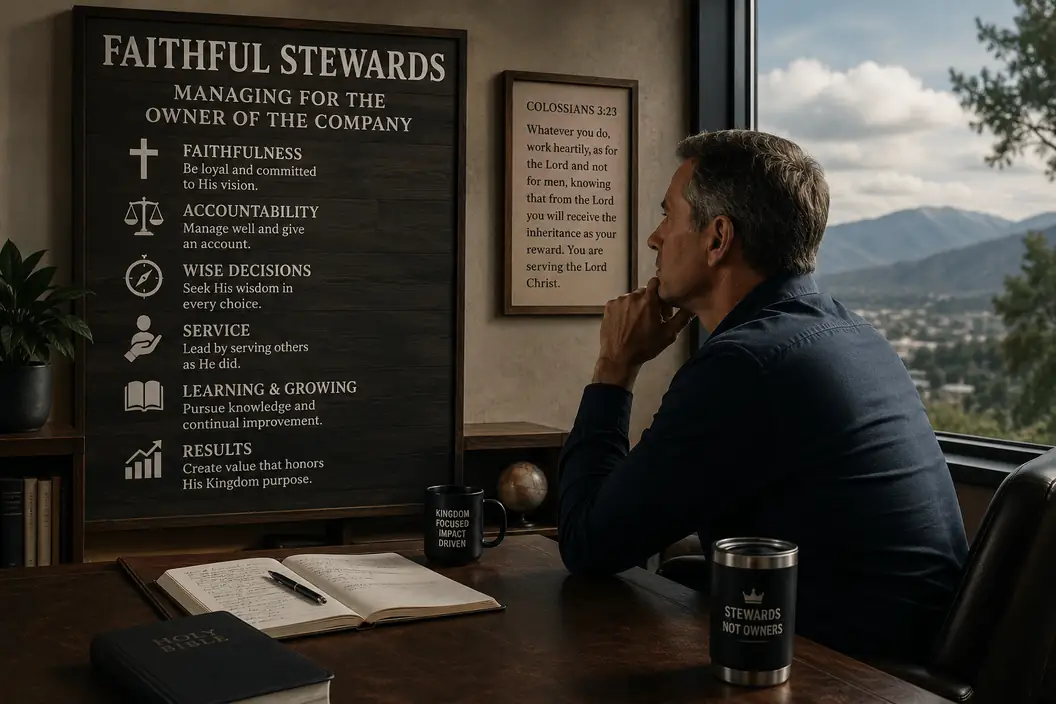
I often hear it said, “Jesus is the owner of the company.” In fact, one of my favorite BAM operators, BJ, is quoted as telling some of the political leaders in his city when they asked him for something that he would have to ask the boss first. Of course, he meant Jesus. What does Jesus expect of me as manager?
Jesus calls his managerial servants stewards.” In the context of God’s Kingdom, a steward is entrusted with the care and management of God’s creation, gifts, and servants. The concept of steward is introduced in Genesis 1:28 but refined in Matthew 25:14-30. So, as a steward, there are expectations for me as CEO or manager of the business, with Jesus as the boss.
- Faithfulness: A key attribute of a steward is faithfulness. In 1 Corinthians 4:2, Paul writes, “Now it is required of stewards that they be found faithful.” This involves a commitment to carrying out the Master’s orders with integrity and dedication; it means knowing the vision, purpose and goals of the business and resisting mission drift. To understand the mind of the owner, we must “know him” – his heart and his expectations. During Covid, Tim’s Coffee and Bakery in SE Asia made some significant pivots, but the temporal owner called the 30+ managers together to remind them that they were going to be faithful to the original founding purpose and vision.
- Accountability: Stewards are accountable to God for how they manage. Romans 14:12 states, “So then, each of us will give an account of himself to God.” Take time to access the resources under your management. You are accountable to God for HR, assets, accounts receivable, P&L, communication, core values, goals and end results. Barrington Gifts is a Dallas, Texas company that has a sourcing factory in East Asia. I toured the company in Asia with the manager. It was clear that he was accountable to the owners in the USA, and as a BAM company, he was accountable to God.
- Wise Decisions: Effective stewardship requires wisdom and discernment. In Luke 12:42-44, Jesus describes the wise and faithful manager whom the master puts in charge of his household. Wisdom enables managers to prioritize integrity and trust; it enables a good match of talent with roles in the company. More than one business owner has suggested reading from the book of Proverbs every day.
- Service: Stewards are called to serve others, reflecting the servant leadership exemplified by Christ. In 1 Peter 4:10, believers are exhorted, “As good stewards of the manifold grace of God, each of you should use whatever gift he has received to serve one another.” In business, this means serving the needs of the customer and meeting the concerns of employees and vendors. Serving others demonstrates what God’s Kingdom is like. Dave Kier spent his career in the animal feed business, and when I visited the plant in Iowa, it was evident that everyone from a top-tier manager to a new hire in the plant loved their job. Why? Dave modeled the idea of being a servant. He demonstrated humility and service to employees and customers.
- Learning and Growing: I managed the home office of our agency for 17 years. I made it clear from the start that I wanted each of the 40 or so employees to keep up with the latest technology and trends so when they leave our employment, they would be competitive in the labor market. When we moved our office to another state more than a thousand miles away in 2010, each person who was not moving found local employment within a few months. Even though it was hard for some, we developed a culture of continual learning. And of course, it is a Biblical thing to do. “Let the wise hear and increase in learning, and the one who understands obtain guidance.” – Proverbs 1:5 and “An intelligent heart acquires knowledge, and the ear of the wise seeks knowledge.” – Proverbs 18:15 and “Let the word of Christ dwell in you richly, teaching and admonishing one another in all wisdom.” – Colossians 3:16. These are three verses on this topic which proves the importance of learning and growing.
- Results: Every owner has expectations of the management. When I was in business school, I was taught the theory of Milton Friedman, which concludes that the purpose of business is to gain profit for the shareholders. Today, students are taught that the purpose is to create value for the customers. It is more than semantics – it goes to the heart of expected results. Coffee exporter, Ryan Stowell, began with the promise to coffee farmers that he will provide good, consistent, and high margins for their product. He wanted happy farmers. There must be a profit, but the primary and secondary results must be clear. The owners expect results. BAM owners also expect results, sometimes articulated with the Quadruple Bottom Line: Profits, Job creation, Disciples of Jesus and good stewardship. They aim for positive results for all four. The owner is watching.
Larry W. Sharp, BAM Support Specialist, IBEC Ventures
Larry.Sharp@ibecventures.com