
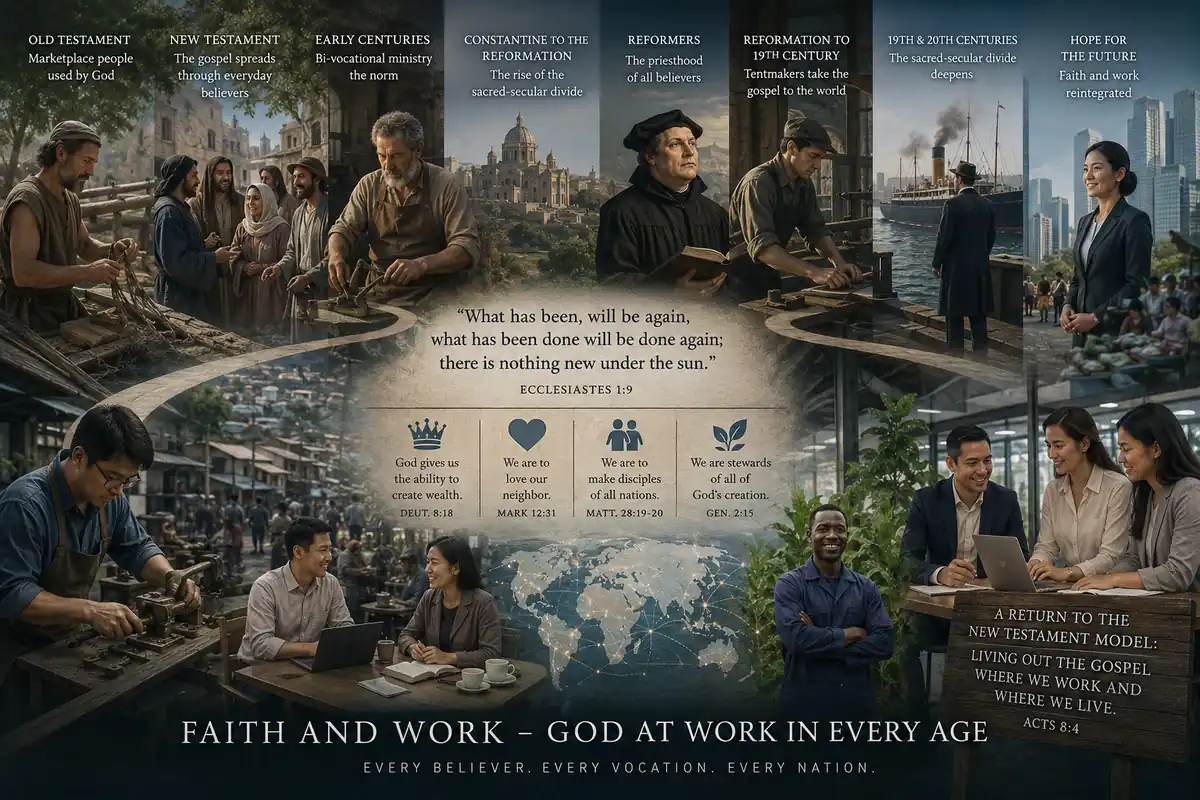
Recently, I was reading the Bible verse which says: “What has been, will be again, what has been done will be done again; there is nothing new under the sun.” Eccl. 1:9. I am sure that in our age of innovation and entrepreneurship, people might want to dispute it but let us take it at face value regarding Business as Mission (BAM).
Some imply that BAM is something new and some even have told me that it is a passing fad; but, what about the essence of BAM? BAM believes Deut. 8:18 where God tells Moses that He (God) give mankind the ability to create wealth. BAM believes the Great Commandment of Jesus that we love our neighbor (MK 12:31), one application of which is to create jobs. BAM believes we are to make disciples of Jesus (MT 28:19-20). BAM believes that we are to be stewards of all of God’s creation (Gen 2:15).
All of that did not start 30 years ago. The latest iteration of it may have; but not the essence of it. Let’s look at a super-short history of God at work in the world.
Old Testament Think of any character in the Old Testament and while there are many prophets, most were marketplace people, whom God used to accomplish his purposes – Noah, Abraham, Moses, Boaz, Daniel, David, Deborah, Gideon, Hezekiah, Job, Nehemiah, and more.
New Testament While the New Testament is rightly heavy on the apostles, especially Paul, Acts 8:1-4 explains how the gospel spread so quickly. “…all except the apostles were scattered throughout Judea and Samaria” and they “…preached the word wherever they went…” In fact, they went even beyond to other places such as Asia and Africa. They met in homes and they lived out the gospel in the marketplace.
Early Centuries Paul’s bi-vocational ministry model was common among apostles, prophets, evangelists and pastors in the Early Church. Tertullian, a renowned 2nd century church father, lauded the practice. It not only provided for God’s servants and for the poor but relieved the growing church of heavy financial burdens.
From the 3rd-5th centuries, prominent bishops in different parts of Christendom were tentmakers. Chrysostom of Constantinople spoke of rural pastors who yoked oxen and drove the plough. Of course, local believers lived out their faith in the workplace.
Constantine to the Reformation We have this era to blame for the “Sacred-Secular Divide.” Constantine (300’s AD) began the practice of paying the clergy and thus began the practice of the professional clergy, something affirmed by Augustine in the 5th century. All the while, the church grew as individuals testified and demonstrated the Good News.
Reformers As Martin Luther declared the “priesthood of the believers”, he challenged the idea of a divide between the sacred and the secular. Luther, Calvin, and other reformers validated the idea that living out the faith at all times was something normal in all venues of life, not something segmented off for the professional clergy.
Reformation to nineteenth century Somewhere along the line, the first-century term “tentmaker” caught on again, and bi-vocational missional workers emerged again. Perhaps most notable were the Moravians who took their trade with them wherever they went. These practical skills contributed to the economic development of the people they served, and provided frequent, natural contacts for spiritual outreach.
The Father of Modern Missions, William Carey, was a tentmaker as he brought spiritual and societal transformation to north India as a plantation manager, college professor, translator, printer and publisher. Similarly, David Livingstone, E. Stanley Jones, Robert Morrison, Gladys Aylward, Lottie Moon, and many others integrated “secular” work with their sacred calling in a holistic transformational manner.
Nineteenth and Twentieth Centuries Phenomenon such as colonial dependency, international banking, the faith mission concept, and the dichotomy of rich and poor nations brought about the demise of tentmaking and exacerbated the sacred-secular divide that we have today. By the end of the twentieth century, the norm was to expect and paid clergy, called missionaries, to spread the gospel while everyone else was to pray and give money. It did not help that many western countries took a well-meaning political ideology called the “separation of church and state” and applied it to all of life, thus allowing the unfortunate “sacred-secular divide” to raise its ugly head.
Hope for the Future Toward the end of the twentieth century, the closing of most countries of the world to missionaries and the development of a robust theology of work gave impetus to a tentmaker strategy again along with the Business as Mission movement. Billy Graham set the tone for what many call the Faith-Work movement, or Marketplace Ministries when he stated, “I believe one of the next great moves of God is going to be through the believers in the workplace.” (Os Hillman in C. Neal Johnson, Business as Mission, 2009, p. 90).
In the “Business as Mission” iteration of God at work in the world of work today, we have the pioneers of the late 1990’s and early 2000’s to thank for the courage to demonstrate and articulate what it is. These are people whose names are familiar to us today, some of whom are MT, JM, JP, NJ, TS, JW, CS, DN, MB, SR, among many others from all continents.
Our Business as Mission strategy is the latest and best outworking of the integration of faith and work. Gea Gort even quotes a friend as saying “Five hundred years ago, we had a reformation of dogma. Now, we have a reformation of mission.” She describes that in one sentence. “It is a missional way of living out the whole incarnated gospel in our daily life, where we work and where we live.”
To my way of thinking, it is a return to the MO of the New Testament believers who “…went from place to place, proclaiming the word.” (Acts 8:4 RSV) or in the words of Michael Green, “…this must often been not formal preaching, but the informal chattering to friends or chance acquaintances, in homes and wine shops, on walks, and around market stalls…they did it naturally, enthusiastically, and with the conviction of those who are not paid to day that sort of thing.” (Green, Evangelism in the Early Church,1970, p. 173).
Larry W. Sharp, BAM Support Specialist, IBEC Ventures
Larry.Sharp@ibecventures.com